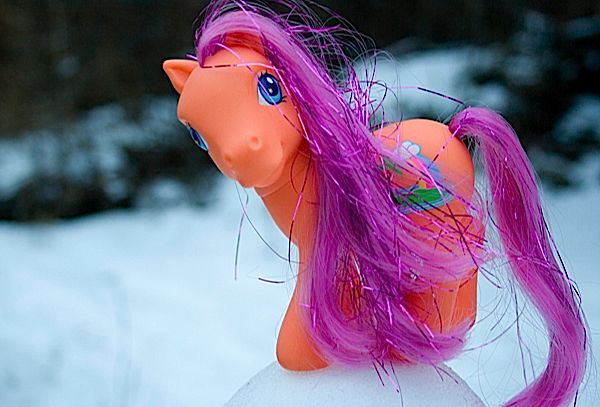
On the drive back from Madison yesterday, I listened to a lecture by MIT psychologist Sherry Turkle on the very personal relationships we have with objects, particularly the objects that help us think. Turkle talked about her 2008 book, Falling for Science, a collection of interviews with MIT students, and established scientists, about the objects that first drew their minds to math, computers, science and technology. Some were what you'd expect: Broken radios, Legos, a computer. But one story, about a My Little Pony, really caught my attention.
I had several small plastic Ponies that I used to play make-believe with my friends. But I had one larger, plush My Little Pony, a bright-green stuffed horse with a vivid pink mane and tail that I played with all by myself. I would sit for hours on my own, braiding and rebraiding its tail. I developed a system for braiding the tail of my Pony that taught me about mathematical concepts– from division to recursion.
Read more of computer scientist Christine Alvarado's story after the cut.
When I started, I took the hair on the Pony's tail and divided it into three pieces for braiding. Soon I became bored with a single braid. I then divided the tail into nine pieces and made three groups. I braided each group of three until I had three braids, then took these three braids and braided them together.
Soon I was up to starting with twenty-seven pieces (nested down to nine braids, then to three and then one) and then on to eighty-one. All the while I was learning about math: I saw that division is the process of taking a large number of things and grouping them into a smaller number of groups. In order to end up with one even braid at the end, I had to be able to divide the initial number evenly by three, then by three,and then by three again, until I ended up with just one braid.
I learned that I had to start with speciï¬c numbers of pieces in order for the braid to come out evenly. These speciï¬c numbers, of course, turned out to be powers of three. Overall, though, what I liked most about braiding was recursion. The large braid was made up of smaller braids that in turn were also made up of smaller braids, and I pushed this structure as far as I could take it. I once attempted to begin the braiding process with 243 pieces, but because each of these sections consisted of only about ï¬ve strands of hair, I was forced to give it up.
With braiding on my mind, I began to see recursion everywhere. One night at the dinner table, I was eating cauliflower and I noticed that it had the same recursive structure of my braids. Moreover, the cauliflower seemed to continue to recurse forever. I began to divide the piece of cauliflower on my plate, determined to ï¬nd the base level, but it split further and further until the pieces were too tiny to hold. My parents gave me a strange glance, and I continued to eat, still fascinated by the underlying structure of my vegetables.
Excerpted from Falling for Science, edited by Sherry Turkle.
Image courtesy Flickr user Katie@!, via CC


