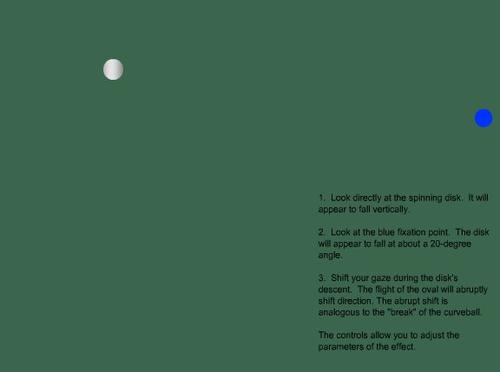
Optical illusion explains the curveball

Here's a sweet little flashtoy (click through to see it in motion) that illustrates the optical illusion behind a curveball: "In baseball, a curveball creates a physical effect and a perceptual puzzle. The physical effect (the curve) arises because the ball's rotation leads to a deflection in the ball's path. The perceptual puzzle arises because the deflection is actually gradual but is often perceived as an abrupt change in direction (the break). Our illusions suggest that the perceived "break" may be caused by the transition from the central visual system to the peripheral visual system. Like a curveball, the spinning disks in the illusions appear to abruptly change direction when an observer switches from foveal to peripheral viewing."
The break of the curveball (Thanks, Fipi Lele!)
Previously:
- Trippy illusion - Boing Boing
- Cognitive scientist on optical illusions and seeing into the ...
- Mr Angry and Mrs Calm optical illusion - Boing Boing
- Twirling dancer optical illusion - Boing Boing
- Optical illusion's effects last overnight - Boing Boing
- Dancing almond optical illusion - Boing Boing
- Optical illusion T-shirt design - Boing Boing
- Dragon Optical Illusion - Boing Boing


the latest
latest episodes
That's a pretty cool illusion.
I'd like to hear Mr. Physicist explain why the Bernoulli effect (you know, high air pressure on one side, low air pressure on the other) doesn't move a curveball and it's all just 'an illusion'.
Whatever. I'm not saying this doesn't play a part, but I've been behind the plate catching guys whose pitches moved from head high and inside on a right-handed batter to low and outside when it crossed the plate. Gravity could account for the 'drop' but I'm waiting for the explanation of the 'side-to-side.'
Curve balls DO curve. Planes do fly. And yes, the world is not flat.
I didn't play ball at a level where I saw many good curves, but the few I did futilely wave at convinced me that my earlier goals of cowboy or fireman would be easier to achieve.
Hmmm. I thought I had seen something on Discovery/Science/whatever that determined it *was* actually curving in flight due to turbulence and drag created with inequality on different sides of the ball by to the seams and rotation.
Sort of like how helicopter blades on opposing sides are moving at different speeds as the rotor rotates while the craft is flying forward, which is compensated by the tail rotor to offset the crafts tendency to spin.
BBONYX, they are saying that curve is really happening (the physical effect), but saying there is also a perceptual effect.
That may be, but the ball does "break" due to physical effects. The sideways force on the ball is close to constant--therefore the ball will accelerate sideways (in addition to accelerating downward due to gravity), moving slowly at first and then more rapidly (sideways and down) as it gets closer to home plate.
I sat a few times behind home-plate at Chavez (Dodger Stadium) back in the day — in the worms-eye-view box seats — and got to track a bunch of Sandy Koufax curve-balls. Let me assure you, his curve definitely *broke* and it was a thing of rare beauty indeed. I was far enough away so that it was NOT an optical illusion. The goddamn thing darted around corners. I saw what I saw. The batters, who were standing right on top of it, didn't have a chance.
This isn't saying that a curve ball doesn't curve -- but I agree that since the simulation just goes straight, it does seem as if that's what they are saying. It would have been good if they had had a version where the ball was curving, and moving your eyes made the curve actually break -- that is, curve much harder, suddenly.
christov: I don't think that the acceleration is the explanation for breaking. After all, anything that curves is accelerating sideways (or it wouldn't curve, it would just move on a diagonal). So, assuming there is a distinction between "curving" and "breaking," where breaking implies a sudden increase in curvature, that would only be explained by an increase in acceleration. You'd have to work with Bernoulli for a while to come up with an explanation as to why the acceleration (and force) would suddenly increase.
MLB itself has the technology that tracks pitch movement. You can view pitchers based on the average break of their curveball, etc.
To say a curveball is in "illusion" is ridiculous. Even fastballs break several inches when thrown by competent pitchers.
Dear everyone-who-says-that-curveballs-really-do-curve.
Yes
They do.
This article isn't disputing that.
What they're saying is that the appearance of a *sudden* shift on motion (i.e. break) may be partially due to an optical illusion. While the ball has a continuous acceleration down, and a continuous acceleration sideways due to the spinning, the physics don't support any discontinuity in this acceleration, i.e. any "jerk", or rate of change of acceleration.
On the other hand, if you go from looking at a spinning object and then look away, so that the object is now in your peripheral vision, the motion of the object appears to suddenly change.
That's why Coach always said, "Keep your eye on the ball!"