From GeekDad Project to a Real Business (via Futurismic)
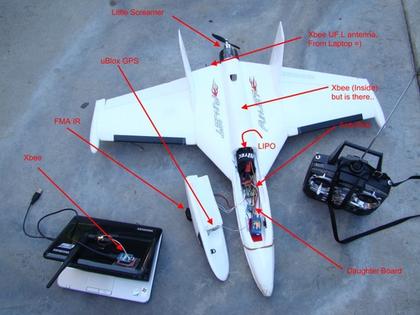
Now this project has gone pro. Our first commercial autopilot, the Arduino-compatible ArduPilot, has been released and our goal of taking an order or two of magnitude out of the cost of an autopilot has been achieved: it's $24.95!Combined with a RC plane, this makes it easy to build a complete UAV for less than $500, which is really kind of amazing. As exciting as that it is, it's also sobering to know that a technology that was just a few years ago the sole domain of the military is now within the reach of amateurs, so we spend a lot of time educating our community on FAA regulations and safe and responsible flying (always under 400 feet, stay within line of site, pilot always able to regain control).
- Fighting the wildfires with a NASA UAV and Google Earth - Boing Boing
- Katrina: UAV drones sent in for survivor search - Boing Boing
- NPR "Xeni Tech": surveillance drones over LA skies - Boing Boing
- Army's unmanned aerial drone kills for the first time - Boing Boing
- Wired science features Chris Anderson's DIY UAVs - Boing Boing


I was thinking about this recently, after reading how much those Predator drones cost!
Seemed to me that an frugal military-industrial complex could get some RC geeks together and build something like this. Not as capable as the Predator of course, but very effective for its cost.
Nice to be proven right.
given that the government and military are happy to spend tons of money on stuff that doesn't work at all (e.g. shotspotter), predators must therefore cost about a trillion dollars apiece.
I was thinking about this recently, after reading how much those Predator drones cost!
Predators weigh over 2,000 pounds, have a near 50' wingspan and are powered by a 1.2L 4 cylinder engine. They're not R/C toys, they're full sized aircraft that happen to be unmanned.
This is a really cool thing, one thing I always wished I had in my R/C airplanes was a "return to home" feature if radio contact is lost. Obviously that doesn't protect against trees, but such are the dangers of R/C models.
that's all well and good, but where do you mount the guns?
The predator weighs about a ton, has a top speed of 130mph, and can carry two 100 pound hellfire missiles.
There are a number of tactical surveillance systems being worked on that would be deployed on the platoon level. tiny, hand launched, styrofoam planes with remote video cameras.
Back to the topic at hand, this is pretty damn cool for $25.
How much would a swarm cost?
While I definitely think this is cool and want one myself, some other people might be interested in another point of view that I heard just this morning on Democracy Now.
The guest from somewhere near the middle to 10 minutes before the end was P.W. Singer talking about his new book Wired for War on the rise of mechanized and robotic warfare. Of note is the story of a soldier commuting to the war in Afghanistan, fought remotely from his drone control station in Nevada, and able to attend the PTA meeting after his 12 hour shift. There are more than a few ethics concerns raised, too.
http://www.democracynow.org/2009/2/6/stream or http://archive.wbai.org/files/mp3/090206_090001dn.MP3 The next file in the list on http://archive.wbai.org/ is not actually Counterspin, but a pledge drive with some excerpts of a talk he gave just the night before (some parts are redundant with the interview, but there were enough interesting parts to make it worthwhile).
combine this with a small radar magnifier and the feds will think there is a real plane in the air. The second amendment should apply to these too, even unarmed they can be very useful in self defense against rogue governments like the USA. If I was rich I would pass out thousands of these to pot growers in the emerald triangle for use defending liberty. I can't wait till they get big enough to carry a payload.
I once worked with one of these devices that can turn an RC plane into an autonomous drone. It had two pressure sensors (pitot-static), a three-axis gyroscope/accelerometer, and GPS (so, all the sensors needed to know the location and speed and orientation of the airplane, each in 3 dimensions), and a controls system that went between the radio and the servos, where you could input gains (basically the estimated effects of different kinds of inputs on orientation and speed) and have it fly itself.
After weeks of work, our group managed to get the sensors all working, so we got very cool telemetry on exactly what the airplane was doing. However, getting it to fly itself was another matter, even after the most complicated controls-system analysis I have ever done in my life, with Matlab scripts estimating stability by plotting poles in the complex plane and all that, plotting responses over time so we could tweak the damping, etc. (Some of which was slightly over my head, to be honest). We probably could have done it given another couple of weeks.
Oh yeah, and the thing cost somewhere around $10,000 (RC plane not included). Somehow I'm guessing that the $24.95 one doesn't have GPS, three accelerometers, or two pressure sensors (in which case I wonder how it closes the loop of the control systems). But I could be wrong, Chinese manufacturing surprises me all the time.
And in any case, I need to get back into RC flying, especially now that all this high tech is small and light and cheap enough to be carried by something smaller than a Global Hawk or Condor.
These are NOT "Autonomous aerial drones". Doesn't anyone at BB own a dictionary? They would only be autonomous if they could fly by themselves, without human interaction. Lazy reporting.
Autonomous Drone? Autonomous Drone? Drone! Not Autonomous Drone! Drone! Drone! Don't you check these things?! That's the definition of drone. Pilotless airplane! Drone! Drone! Drone!
Line of SITE?
Don't rely on spellcheck alone.
jungletek,
FYI - we don't correct quoted source material, just our own typos.
You know, it's only a matter of time before R/C model aircraft are outlawed as a potential terrorist weapon.
"As exciting as that it is, it's also sobering to know that a technology that was just a few years ago the sole domain of the military is now within the reach of amateurs..."
It has already been available to the public for a few years, if not loner. Perhaps not as cheaply or as easily, but that was only a matter of time, anyway. Hardly the sole domain of the military at all.
@#10: And what leads you to say that? This appears to be able to fly by itself, and I've seen systems over a year ago that can land themselves and change their course depending on objectives or failures.
@#1: You can't compare a Predator to a normal RC aircraft. The principles may be similar, but practically, the equipment is very different. You don't just strap Hellfire missiles to anything, and the size of these UAVs alone makes them something else (hobby-grade RC aircraft are restricted in size (often by law, I think). It's like comparing a go-cart to a top-of-the-line Mercedes.
What does an auto-pilot do?
1) punch a few numbers into the controller, the plane takes off, flies to buiding X, and lands on the roof.
2) keep the plane flying in the same direction, and altitude (even if it's into the side of a hill).
3) keeps the plane from diving for the ground when you put down the controls (like RC blimps can do, without any auto-pilot, you just turn off the engine).
Isn't a drone an RC plane, with extremely long radio range, plus video camera that transmit live video to the operator, so that he can fly it as if he's sitting in the 2 feet plane?
Alex M @1 - The US have squad deployed light RC recon planes now, operated in the field. They're light, unarmed, and have a limited range.
Predators are drone aircraft remotely operated from a base in Alaska (mostly). They can refuel in the air (or so i hear) and carry missiles.