Ether-drift-detecting machine from 1932

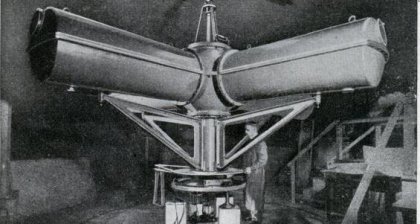
The December, 1932 ish of Modern Mechanix immortalized this wondrous and loony German machine that measured the drift of the ether, "that impalpable substance which, according to one school of thought, fills the space in which the universe swims."

It is an apparatus to measure the drift of the ether, that impalpable substance which, according to one school of thought, fills the space in which the universe swims. Theoretically the motion of the earth, passing through this ether, should set up a drift comparable to the breeze generated by the motion of an automobile through the air.

To determine if such a drift actually does exist, the elaborate optical apparatus shown on this page was built by German scientists It consists of four arms on a perpendicular axis, containing a series of mirrors, lenses, and reflecting plates. A ray of light enters at the top of the device and is bounced back and forth thousands of times, finally emerging at the bottom, where its passing leaves a record on a photographic plate.
Link

Discussion

Take a look at this

This machine is hardly looney. The luminiferous ether (http://en.wikipedia.org/wiki/Luminiferous_aether)
was an established part of the scientific worldview as late as the early 20th century. Many attempts to detect it and measure it's properties were made. Special relativity came along and didn't require an ether, so Occams razor cut it out of the standard model.

Pick up an astronomy textbook from ~1905 or so and it will have a whole chapter on it.

Science, it works, Bitches!

Take a look at this

It looks like a Michelson–Morley interferometer. Well actually it looks like a crazy battleship cannon, but it most certainly is a Michelson-Morley interferometer.

Ah, the fun of measuring for ether. A substance that must be stiff so that it allowed light to be transmitted at incredible speeds yet at the same time somehow be fluid to allow the planets and other celestial objects to easily move through space. You have to love these ether measurement experiments--measuring zero to increasingly higher precision. I think they've got the ether drift measurement down to a precision of tens of meters per second now.

Take a look at this

Agreed. This was one of many serious attempts to detect the medium in which light travels as a wave (much as sound travels as a wave in air).

AFAIK no experiment disproved the existence of ether, though none of them proved it either. (Please correct me if I am wrong here.)

The hypothesis was later abandoned when other (bizarre though consistent with the facts) explanations were developed for why light exhibits wave-like behaviour.

Take a look at this

Nikola Tesla ascribed to the theory of aether, and tubes of force coming from the sun.
Along comes Einstein who rains on the aether parade with Relativity, which Tesla scorned as,

"...[a] magnificent mathematical garb which fascinates, dazzles and makes people blind to the underlying errors. The theory is like a beggar clothed in purple whom ignorant people take for a king..., its exponents are brilliant men but they are metaphysicists rather than scientists..."

Take a look at this

wow really impressive, its like in a sience fiction movie, cannot explain i´m simply impressed.

Take a look at this
"...[a] magnificent mathematical garb which fascinates, dazzles and makes people blind to the underlying errors. The theory is like a beggar clothed in purple whom ignorant people take for a king..., its exponents are brilliant men but they are metaphysicists rather than scientists..."
Alluding to Ernst Mach and the relativists in philosophy of science at the time, IIRC.
Ah, the fun of measuring for ether. A substance that must be stiff so that it allowed light to be transmitted at incredible speeds yet at the same time somehow be fluid to allow the planets and other celestial objects to easily move through space. You have to love these ether measurement experiments--measuring zero to increasingly higher precision.
Anyone care to explain how "the fabric of spacetime" is not simply the "aether" (or whatever you want to call it)? Afterall, space/vacuum is not "nothing"; it is a medium itself.

p.s. Obligatory mention of the Ether Drift Theory episode of Aeon Flux.

Take a look at this

It doesn't seem any wackier than current experiments to detect gravity waves:

http://www.ligo-la.caltech.edu/contents/overviewsci.htm

The method even looks similar, light beams bouncing back and forth thousands of times between two mirrors and looking for changes with some type of detector.

Take a look at this

I agree that it appears to be a Michelson–Morley interferometer. It was anything but "looney"! Had it not been for that magnificent experiment, Lorentz would not have needed to theorize space contraction and Einstein would not have invented relativity. It was one of the most seminal physics experiments of all time, comparable in its implications to Galileo's. Indeed, Michelson won the Noble prize for it in 1907. That said, I don't understand why this photo is in a 1932 magazine; the M-M experiment was published in 1887!

http://en.wikipedia.org/wiki/Michelson-Morley_experiment


Take a look at this

But... manipulation of the Aether is essential for the proper playing of the Moog Etherwave Theremin!

Take a look at this

Oink: there was some question about Relativity and the MM experiment for quite some time, especially in pre-WWII Germany where it was dismissed as "Jew Science". The debate on relativity had a very loud period put at the end by the Little Boy detonation over Hiroshima, and the MM experiment was run mainly to confirm "yep, still zero within limits of measurement".

Take a look at this

This thing might not be able to detect the aether, but maybe it can detect dark matter. Someone should test it!

Take a look at this

We're made of dark matter. Or are you talking about WIMPs?

Take a look at this

The main benefit of this setup seems to be that it provided photographic evidence for the first time, showing the interference fringes and the fact that they don't shift relative to each other. Other setups of Michelson-Morley relied on an experimenter who wrote down the results.

The odd appearance consists of the two legs of the interferometer inside vacuum chambers at right angles, mounted on some kind of contraption to isolate it from ground vibration. The original 1897 experiment was open-air on a heavy stone table floating on a cushion of oil, IIRC.

Take a look at this

"Pick up an astronomy textbook from ~1905 or so and it will have a whole chapter on it."

its been a while since i studied the dates involved but i think by 32 they had pretty much abandoned the theory.

A lowly patent clerk named Einstein had done some work in that regards that got him some attention.

Take a look at this

Zuzu wrote:
Anyone care to explain how "the fabric of spacetime" is not simply the "aether" (or whatever you want to call it)?

The distinguishing feature of the aether is that it is a physical substance with a definite rest frame of its own--any given object will have some definite velocity relative to the aether in its own local neighborhood. But in relativity there is a complete symmetry between observers moving at different velocities--the laws of physics in their own local region will look exactly the same regardless of their velocities relative to one another (so if you have two experimenters in small windowless boxes in motion relative to one another, and each performs identical experiments, they'll get identical results, or at least identical statistics if the laws of physics have a random element). So, if relativity is correct no possible experiment could determine one's velocity relative to the aether...this doesn't exactly prove it doesn't exist, but it at least relegates it to the realm of metaphysical speculations as opposed to testable physics.

Take a look at this

The Nazi's also sent a team to the arctic to perform an experiment to see if the earth was hollow. Loony does describe them quite well.

Take a look at this

Noen, Hitler didn't actually become chancellor until Jan. 1933 and I'm sure it took a while before Nazi ideology started affecting scientific research. This experiment wasn't really very "loony" in the context of 1932 physics, especially if the scientists were expecting the most likely result to be a confirmation of relativity, in much the same way that the recent gravity probe B experiment will most likely confirm general relativity's predictions rather than show a flaw in them. Even if you're fairly confident an existing theory is right, it's still worth the effort to subject it to the most exact experimental tests possible.

Take a look at this

This device also reminds me of Wilhelm Reich's "cloudbuster." Wikipedia says that many claim this device is "pseudoscientific," though a number of weather modification businesses use this device, and they've been hired by large corporations and even nations. Cloudbusters have been used by some to combat "chemtrails." Reich's "Contact With Space" book has amazing tales of Reich shooting the cloudbuster at EA's (ufos) and DOR (or deadly orgone) in the Arizona desert. See more here: http://en.wikipedia.org/wiki/Wilhelm_Reich

Take a look at this

The original measure-the-aether experiment was back in the late 19th century, and by 1905 Einstein's special theory of relativity put the last stake in the heart of the ether theory. Mind you, some bits and pieces still poke out. For example, when someone talks about "high tension" wires, they are referring to the aether theory of electrical force in which high voltages represent a high tension in the fabric of the ether.

If the Germans were trying to measure the aether in 1932 it was clearly part of the anti-Jewish science movement. Einstein, after all, was Jewish. Luckily, being anti-Jewish doesn't work that well in a technological war. The World War I, from a Jewish scientist's viewpoint, was Fritz Haber versus Chaim Weitzman, both Jewish. Both sides in the war needed fixed nitrogen for explosives, so Haber developed a high pressure process and Weitzman developed a seaweed to acetone process. (Weitzman was later president of Israel).

In World War II, the Nazi effort to develop an atomic bomb was hamstrung by their refusal to accept the Jewish estimate of the capture cross section of graphite, a rather common material. The proper Aryan material for catching neutrons was heavy water, which is relatively rare. As it turned out, neutrons didn't give a damn.

Take a look at this

Loonie? Michelson–Morley was a first attempt at measuring a theoretical feature predicted by classical physics. The failure to detect an aether was surprising to most physicists, hence the interest in refining the measurement when technology allowed.

A similar process of refinements can be seen in periodic measurements of the equivalence between inertial and gravitational mass, which started with Lorand Eotvos.
http://en.wikipedia.org/wiki/Loránd_Eötvös
http://www.kfki.hu/~tudtor/eotvos1/onehund.html


Take a look at this

Oh you heathen, Kabbalist, Commie, Copernicanist, Big-Bangism spouting, Evolutionist fools! Don't you know anything?! The Michelson-Morley experiments had nothing to do with aether, they proved the Earth doesn't move!!!!! (http://www.fixedearth.com/Assumptions.htm)

Just joking of course, but the discussion reminded me of the Fixed Earth site. I don't believe this crap, but someone in the Texas state legislature does, enough to send links to all of the other legislators.
But I thought the creator of the site was a lone nut. Much to my dismay, I realized how many people agree with his interpretation of the experiments. Google pulled back a frightening number of sites that stated the same thing.

Take a look at this

Kaleberg wrote (post #20):
The original measure-the-aether experiment was back in the late 19th century, and by 1905 Einstein's special theory of relativity put the last stake in the heart of the ether theory.

A theory can't put a stake in the heart of another theory, only experimental evidence can do that. As I pointed out above, scientists today think it's worth doing the gravity probe B experiment to test general relativity's predictions more precisely, even though everyone is pretty confident that the results will just confirm GR's predictions rather than lead to any new physics; the same was probably true of this experiment.

If the Germans were trying to measure the aether in 1932 it was clearly part of the anti-Jewish science movement.

The article mentions the experiment was performed in Jena, and a little googling shows that an ether drift experiment was performed by the physicist Georg Joos from the University of Jena in the early 1930s--see this page as well as this page which has a picture of Joos' apparatus where you can see it's the same one pictured in the article (the page also shows that many other Michelson-Morley-type experiments were performed throughout the early 20th century). So you're wrong that this was some sort of Nazi experiment to discredit "Jewish science", the wikipedia page mentions that Joos lectured on relativity in the 1920s, that he was a signer of a petition protesting attacks on Jewish physicists (and on certain theories like quantum mechanics) by proponents of so-called "German physics", and that he left academia in 1941 because of Nazi policies.

Take a look at this

My first thought was a laser gyroscope.

http://en.wikipedia.org/wiki/Laser_gyroscope

Turns out I was not far off the mark... (seems the search for ether effect was not wasted) according to : http://en.wikipedia.org/wiki/Michelson-Morley_experiment

Take a look at this

A lot of people here are claiming that Einstein disproved the ether with his special theory of relativity. I disagree. One of his postulates was that the speed of light is constant in all inertial reference frames. This postulate came from the work of Maxwell. Maxwellian electrodynamics showed that light did not need a medium to transfer through and that the speed of light is constant in all inertial reference frames even though it took physicists half a century to accept that. Einstein's contributions were immense, but the way they came from the Michelson-Morley experiment was due to Lorentz. The famous 1/sqrt(1-v^2/c^2) term was invented by Lorenz to allow ether to exist and not contradict one of the early forms of the Michelson-Morley experiment. Einstein just took Lorentz's equations and used them to discuss mechanics in general. While Einstein had to argue for many years to show that his special theory of relativity was correct and that Lorentz's ether theory was wrong, Maxwellian electrodynamics was always firm on the question.

Take a look at this
#26 posted by ia_ , December 24, 2007 5:32 PM

#14 The original Michelson-Morley interferometer experiments were as you described, except floating on liquid mercury which was exposed to the air (yes, gallons of it,) and not oil. Dangerous stuff!

Take a look at this

So much information, so little knowledge!

Yes, this is a Michaelson interferometer. And by 1932 you could still pass as a serious physicist doing ether experiments. Yes, Einstein had pretty much dispensed with the need for an ether model in 1905. But when he won the Nobel Prize in 1921, it was for his explanation of the photoelectric effect. At that time, relativity was still pretty controversial.

The Michaelson-Morley experiments are frequently cited in reconstructed histories of the development of relativity as seminal influences on Einstein's thought. Trouble is, there is absolutely no evidence of this. In Einstein's papers up to the publication of his paper on the electrodynamics of moving bodies in 1905, there is no mention of Michaelson-Morley. As usual, the real history is a great deal more complex and less logical.

Einstein did not "take Lorentz's equations." What Lorentz did was essentially ad hoc curve fitting. He found a function that reproduced the data, but had no justification whatsoever for why time and space measurements should behave in that way. Einstein started with the demand that mechanics should obey the same laws as electrodynamics, and from that *derived* the Lorentz transformations.

Take a look at this

Indeed, even in 1920, Einstein himself still contemplated the possibility of an interstellar aether. It would take many successive experiments of increasing accuracy such as this one to finally and collectively displace aether with an elaborated general relativity. (That's science, after all, you come up with a theory and then use gazillions of measurements to prove it's right.)

In 1932, the same time Dr. Joos built the gadget depicted, other experiments to measure "aether drift" were conducted as well, such as the Kennedy-Thorndike experiment, meant to prove special relativity by measuring length contraction.

As the launch of Gravity Probe B reminds us, we're still conducting experiments to empirically test relativity to this day.

Take a look at this

A bit off-topic, but what's the deal with Germans and machines? Is it a cliched myth?

Take a look at this

Just like those loony knights riding horses - why don't they just use tanks!

Take a look at this

"We're made of dark matter. Or are you talking about WIMPs?"

That's it! Now I know why I'm bad! I'm just make of dark matter! And I'm a wimp, too.

Jeff

Take a look at this

#5 posted by theRat , December 24, 2007 6:58 AM

http://dresdencodak.com/cartoons/dc_028.htm
Fantastic!

Post a comment

Anonymous