Master Chao: Chinese virtuouso flat-pattern designer

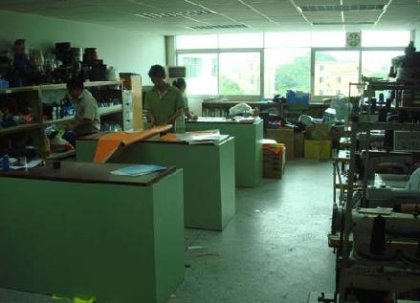
Andrew "bunnie" Huang -- the guy who broke the Xbox and founded Chumby -- has a great blog post today about Master Chao, a middle-aged Chinese man who has helped design thousands of everyday products that fill your gadget bag and home. Master Chao's gift is in creating flat patterns for sewing into three dimensional shapes, something that is insanely hard to model well on computers. I heard bunnie give a talk on Chinese manufacturing process last June, and his lyrical description of Master Chao's virtuoso performance has stayed with me.

It turns out there are still things where Craft, and I use it with a capital "C" here, matters-it's where CAD tools haven't brought about the ability to simulate out our mistakes before we build them. The creation of a flat pattern for textile goods is a good example of a process that requires a Craftsman. A flat pattern is the set of 2-D shapes used to guide the cutting of fabrics. These 2-D shapes are cut, folded and sewn into a complex 3-D shape. Mapping the projection of an arbitrary 3-D shape onto a 2-D surface with minimal waste area between the pieces is hard enough; the fact that the material stretches and distorts, sometimes in an anisotropic fashion, and the fact that sewing requires ample tolerances for good yields makes it a difficult problem to automate. On the chumby, we add another level of complexity, because we sew a piece of leather onto a soft plastic frame. As you sew the leather on, the frame will distort slightly and stretch the leather out, creating a sewing bias dependent upon the direction and rate of sewing. This force is captured in the seams and contributes to the final shape of the device. I challenge someone to make a computer simulation tool that can accurately capture those forces and predict how a device will look at the end of the day.

Yet, somehow, Master Chao's proficiency in the art of pattern making enables him to very quickly, and in very few iterations, create and tweak a pattern that compensates for all of this. It's astounding how clever and how insightful the results can be. And really, the point of this particular post is to introduce you to a person whose old-world skills -- absent computers, all done with cardboard, scissors and pencils -- has likely played a role in the production of something that you have used or benefited from in the course of your life.
Link

See also:
Bunnie Huang's blog-series on Chinese manufacturing
Xbox hacker's view of manufacturing in China


Discussion

Take a look at this

We do this kind of thing in the inflatable biz all the time. Cut and sew then blow up, it all wants to go round. We design by hand and experience. Take an orange or anything round, flatten it and you will see the complex shapes that are involved when thinking in 2-D flat world. We call that reverse engineering. But go the other way and design a human face out of flat material and you will be challenged. They do have softwares on the market that can do this but you need 3 different ones to take you from design, to pattern 2-D layout to computer cutting, then assemble. Check out my site for some inflatable examples. www.airfilledproducts.com

Take a look at this

I'm really excited to see this here; I'm a pattern maker, have been for 27 years. I've been blogging about it for the past two and half years, in which time, I think I've successfully communicated the demand of the craft. And it is a craft. Pattern making is a complex hybrid of materials and industrial engineering. Not only must we design translating two into three dimensions encompassing the variation of fiber behaviors, our patterns must be designed for manufacturability. It serves no purpose if it can't be sewn by the specific machine appropriate for the given operation.

These days, the big push is in CAD pattern making. It's not so much that CAD can't be a useful tool, the problem is that manufacturers have tended to hire recent grades with CAD training but little drafting experience. Worse, they're using templates that come preloaded in the system, they don't have the skills to build from scratch. This would be like hiring someone to design your documents who was proficient with Word, and who'd use Word templates as the basis of your docs. Ack!

Unfortunately, it is precisely the use of CAD that is the greatest impetus towards the degradation of garment fit. As I said, it's not so much that CAD is bad per se, it's the people hired to operate the systems. Unfortunately, it's consumers paying the price

Take a look at this

I used to do old-school design engineering for folded steel (our parent company specialized in metal enclosures). Designing for flat pattern steel is quite fun, like metal origami. Our factory in this small Swedish town had these masterful tool-die guys who were amazing at translating our design prints into real patterns, tools/dies, and processes for the multiple steps of stamping, folding, spot welding, in the fastest and least wasteful manner possible. A lot of the specific layout tasks are done with CAD now and most of the tool cutting is CNC, but it would be worthless without the decades of hands-on experience/knowledge that these craftspeople have.

Take a look at this
#4 posted by Anonymous , September 11, 2007 12:09 PM

Curently in 3D development, whether it be for games or animation, texturing is key ingredient. This article by it's description is just that. For proper texturing first the UV layout has to be done in a way that there are minimal stretch areas, no visible seams and as little wasted space as possible in the image file.

Post a comment

Anonymous